5 August 2026
Setting Up a Subsidiary in Singapore
Learn how to register a subsidiary in Singapore as a private limited company owned by a local or foreign parent. Contact our consultants for assistance.

Subsidiaries can be registered in Singapore as private limited liability companies whose majority shareholder is another corporation. The parent company can be local or foreign. Our company incorporation experts can assist businessmen who are interested in setting up a private limited company in Singapore with corporate shareholding structures.
| Quick Facts | |
|---|---|
| Applicable legislation | Singapore |
Best Used For | Trading, commercial, online commerce, manufacturing, etc. |
Minimum share capital (YES/NO) | No |
| Time frame for the incorporation (approx.) | Approx. one week |
| Documents to be filed by parent company | – the subsidiary's incorporation documents; – the parent company's Certificate of Registration; – resolution for the appointment of directors; – proof of Singapore legal address; – copy of company representatives in Singapore; – copy of subsidiary director's passport/ID and proof of residential address of the director. |
| Legal representative required (YES/NO) | yes |
| Local bank account (YES/NO) | yes |
| Independence from the parent company | Independent business form |
| Liability of the parent company | No liability for the subsidiary's debts and obligations |
| Corporate tax rate | 17% |
| Annual accounts filing requirements | Estimated Chargeable Income (ECI) must be filed within 3 months after the end of the financial year; the corporate income tax return (Form C-S/C) is due by 30 November; the annual return is filed with ACRA within 7 months after the financial year-end. |
| Possibility of hiring local staff (YES/NO) | Yes |
| Travel requirements for incorporating branch/subsidiary (YES/NO) | No |
| Double tax treaty access (YES/NO) | Yes, to over 100 double tax treaties |
| Special requirements related to the trading name (YES/NO) | No, the subsidiary can bear any name, as long as it is unique. |
Activities permitted | It can undertake both the activities of the parent company, as well as others. |
Restrictions (if any) | No |
| Special licensing requirements (if any) | For certain activities, specific licenses may be required. |
| Local address required (YES/NO) | Yes, this is a mandatory condition for setting up a company in Singapore, including a subsidiary. |
| Authority to be registered with | Accounting and Corporate Regulatory Authority (ACRA) |
| Employment registration requirement (YES/NO) | Yes |
| Option to transfer employees from the headquarters (YES/NO) | Yes, employee transfers are available for this business form. |
| Legal forms that can be used for registration | – private limited liability company, – public company. |
| Audit requirements (if any) | Audits are required for subsidiaries not meeting the small company criteria. |
| Possibility to use a virtual office for registration (YES/NO) | Yes, the virtual office is an option for registration but not in a long term. |
| Applicability of the corporate tax | A subsidiary pays corporate tax on Singapore-sourced income and on foreign income received in Singapore (with exemptions for qualifying foreign dividends, branch profits and service income). |
| Access to tax benefits (YES/NO) | Yes, subsidiaries can access all tax benefits available to domestic enterprises. |
| Advantages | – quick incorporation, – access to multiple grants, – tax deductions and other governmental benefits, – access to numerous markets. |
| Incorporation services availability (YES/NO) | Yes, we can assist with the creation of a subsidiary in Singapore. |
What are the characteristics of a Singapore subsidiary?
Here are the main features of a subsidiary in Singapore:
- it can take the form of a private or public limited liability company and will be treated like a domestic business;
- it will operate as an independent entity, and the management in the Singapore subsidiary will make decisions on its behalf;
- it can undertake the same activities as the parent company; however, it has the freedom to complete additional undertakings;
- from a taxation point of view, the subsidiary is treated like a Singapore tax resident company;
- it can own assets in the form of real estate in Singapore and have its own corporate bank account;
- it will be registered under the regulations of the Company Law in Singapore and will need to meet the incorporation requisites imposed in the city-state.
What are the types of companies that can expand their operations through subsidiaries in Singapore?
The subsidiary can be used by both local and foreign companies; however, more often than not, it is used by foreign entities.
How do I register a subsidiary in Singapore?
The registration process of a Singapore subsidiary is quick and easy once all the documentation has been properly prepared. The first step will be to submit an application for the approval of the subsidiary’s name, and the second step will be the company incorporation. The process usually takes about two days. The Singapore subsidiary must also open a bank account with a local bank.
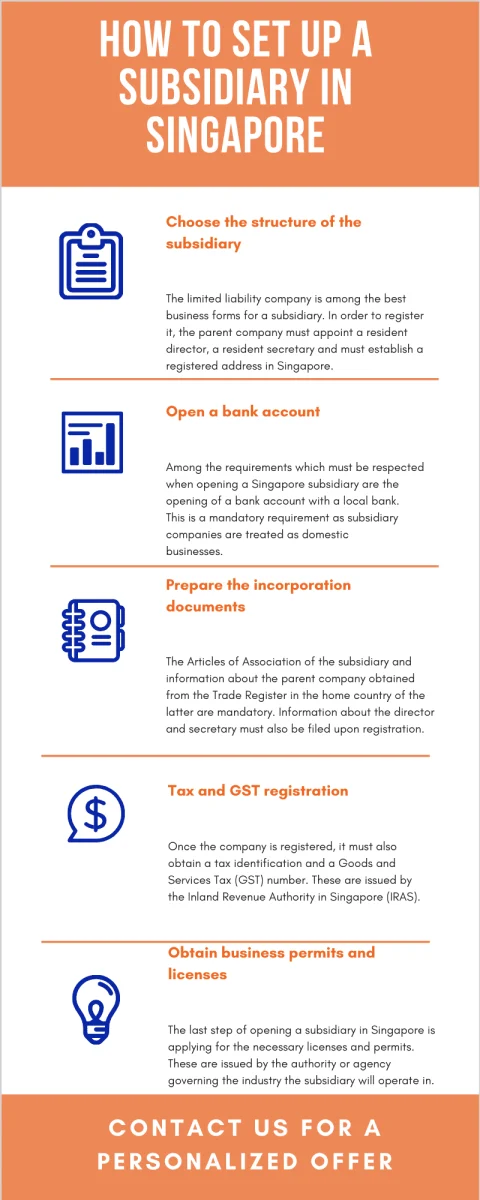
The main particularities of a subsidiary in Singapore are described in this scheme created by our Singapore company formation team:
What are the documents required for setting up a subsidiary in Singapore?
The following documents must be submitted to ACRA:
- the certificate of incorporation of the parent company,
- a statement containing the registered address and directors of the parent company,
- the decision of appointing the subsidiary’s representative in Singapore,
- copies of the passports and proof of residential addresses of the subsidiary’s directors,
- the parent company’s resolution appointing the directors,
- the registered address of the subsidiary in Singapore,
- the Articles of Association of the Singapore subsidiaries.
How can a subsidiary company be defined according to Singapore law?
From a legal stance, the subsidiary is a company that is owned by another entity, which is called as a parent or holding company, depending on the purpose of establishment. The parent company can own a part of the subsidiary’s shares, or it can own it entirely.
What is the most common structure to open a subsidiary in Singapore?
The private limited liability company, where the parent company is the sole shareholder.
Must the subsidiary bear the same name as the parent company, like in the case of a branch?
No, this requirement does not apply to the subsidiary, as compared to a Singapore branch, it does not depend on the parent company.
Is it necessary for a Singapore subsidiary to appoint a secretary?
Yes, and the company secretary must be a Singapore resident.
Is it also necessary for the subsidiary to have a resident director?
Yes, this is a mandatory requirement when setting up a subsidiary in Singapore. However, it is also possible to transfer a person from the parent company’s headquarters for whom a work and residence permit can be obtained. In addition to this person, other directors can be nominated.
How long does it take to register a subsidiary in Singapore in 2026?
It takes about a week to register a subsidiary in Singapore.
Is it possible to incorporate a Singapore subsidiary online/remotely?
Yes, it is. In the case of remote registration, clients can rely on our local specialists for representation with ACRA and IRAS. As a matter of fact, for foreign companies, appointing a local registered agent to complete the incorporation procedure is required.
What are some of the advantages of operating through a subsidiary in Singapore?
Here are some of them:
- full foreign ownership of the parent company, especially in the case of foreign enterprises: this is not possible in all countries;
- limited liability of the parent company: the subsidiary is solely responsible for the debts and obligations it incurs;
- tax residency: the subsidiary is, in fact, a domestic company, which means it can apply for subsidies, grants, incentives, any other benefits, including double tax treaties.
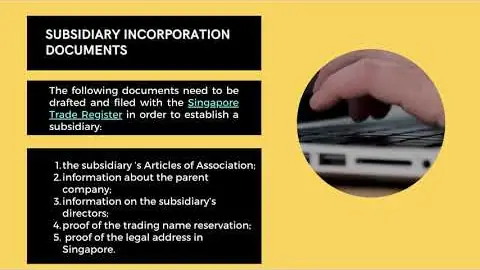
You can also watch the video below for more information on how to open a company in Singapore as a subsidiary:
How are subsidiaries taxed in Singapore?
A Singapore subsidiary will be subject to the same tax regulations applied to all companies registered in the city-state. The corporate tax rate is 17% in Singapore. It is best to ask for accounting services related to the taxation of subsidiary companies in Singapore.
If you want to open a company in Singapore and need advice on choosing a business entity, our local agents can guide you. We can also assist with various nominee services for your subsidiary, among which are a nominee director and secretary, in order to ease your operations in this state. If you want to open a company in another country, such as Luxembourg, we can put you in touch with our local partners.
Please contact our local representatives, who can provide you with all the information about the process of opening a company in Singapore.